
Agent Economy . Infrastructure (B2A Stack)
Structural mapping of the Business-to-Agent (B2A) infrastructure stack across agentic web search and catalog access, managed account authorization, browser, phone, and sandboxed computer execution, programmatic messaging, persistent memory and taste graphs, and delegated payments and checkout. Based on the original "Welcome to the Agent Economy — Infra" market map by Andreessen Horowitz (a16z, Olivia Moore & Justine Moore, November 2026).
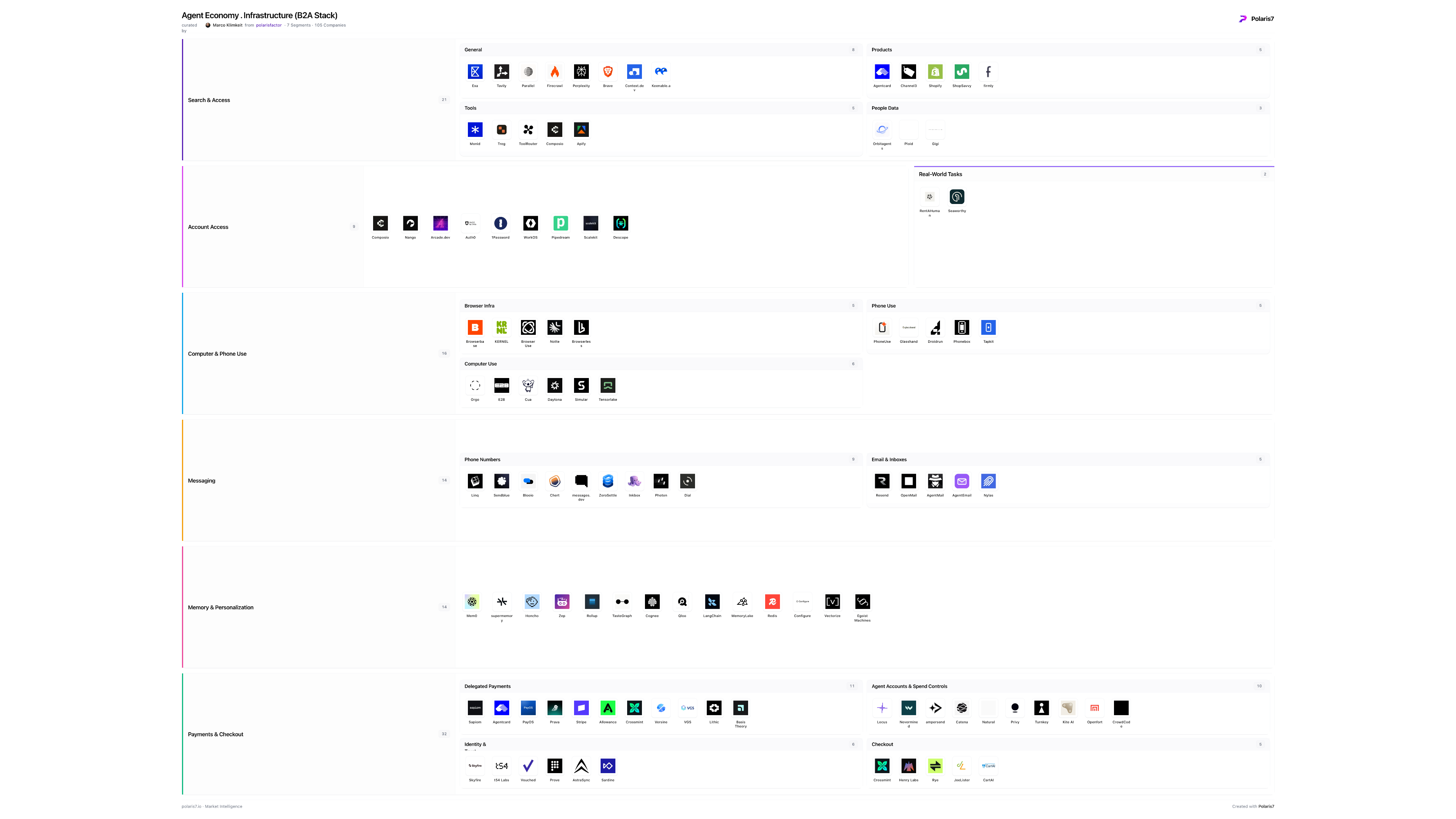

Search & Access
General
People Data
Real-World Tasks
Payments & Checkout
Delegated Payments
Agent Accounts & Spend Controls
Identity & Trust
Segment Breakdown: Agent Economy . Infrastructure (B2A Stack)
Structured breakdown of the functional segments and verified companies in this market landscape.
| Segment | Functional Scope & Sub-Segments | Representative Platforms |
|---|---|---|
| Search & Access | Web search indexes, merchant product catalogs, tool gateways, and relationship graphs built for autonomous AI agents. Sub-segments: General · Products · Tools · People Data | |
| Account Access | Delegated user authentication, OAuth token vaults, and scoped third-party API permissions for agents. | |
| Real-World Tasks | Human-in-the-loop marketplaces and APIs for delegating physical errands and phone calls. | |
| Computer & Phone Use | Hosted headless browsers, physical and cloud mobile devices, and isolated desktop and code sandboxes. Sub-segments: Browser Infra · Phone Use · Computer Use | |
| Messaging | Dedicated phone numbers, iMessage/SMS/WhatsApp bridges, and programmatic email inboxes for agents. Sub-segments: Phone Numbers · Email & Inboxes | |
| Memory & Personalization | Persistent conversational memory layers, temporal knowledge graphs, portable user context, and taste engines. | |
| Payments & Checkout | Delegated payment vaults, virtual card issuing, programmable agent wallets, KYA identity verification, and agentic checkout. Sub-segments: Delegated Payments · Agent Accounts & Spend Controls · Identity & Trust · Checkout |
Market Architecture & Analyst Briefing: Agent Economy . Infrastructure (B2A Stack)
Market Intelligence Report: Agent Economy Infrastructure (B2A Stack)
Executive Summary
The software industry is undergoing a structural paradigm shift from Business-to-Consumer (B2C) and Business-to-Business (B2B) interfaces toward Business-to-Agent (B2A) infrastructure. As Large Language Models (LLMs) and Multimodal Foundation Models advance from passive conversational reasoning to autonomous execution, they encounter friction caused by legacy digital infrastructure designed exclusively for human interaction. Human-centric web pages, graphical user interfaces (GUIs), browser-based authentication flows, payment card rails, and anti-bot mitigation systems impede autonomous software actors.
The B2A Infrastructure Stack resolves this impedance mismatch by providing specialized architectural primitives tailored to autonomous software agents. This ecosystem spans deterministic search indexing, headless execution environments, delegated identity vaults, persistent memory graphs, programmatic communication channels, and policy-governed transaction rails. Capital allocation into the sector has accelerated rapidly, evidenced by significant funding rounds across sandbox virtualization providers (e.g., Daytona), orchestration and governance platforms (e.g., LangChain), messaging gateways (e.g., Linq), and agent-native transaction networks (e.g., Natural, Skyfire, and OpenAI's ChatGPT Wallet).
Key Market Segments
1. Search, Access & Tool Gateways
Autonomous agents require continuous context retrieval and structured real-time external data feeds without the latency, unstructured styling, and anti-bot obstacles of traditional search engines.
- General Web Search & Scrape: Providers such as Exa, Tavily, Parallel, and Firecrawl build purpose-built web search indexes, markdown scrapers, and research endpoints delivering clean, token-efficient, and machine-ingestible data.
- Products & Commercial Catalogs: Specialized catalogs and aggregators (e.g., Channel3, ShopSavvy, Agentcard, firmly) normalize retail SKU data and inventory states for algorithmic shopping agents.
- Tools & API Gateways: Solutions like Composio, Apify, ToolRouter, and Monid expose standardized tool registries, function-calling abstractions, and automated scraping actors.
- People Data: Platforms like Orbitagents and Ploid surface structured professional and entity intelligence to inform B2B agent decision-making.
2. Account Access & Delegated Authentication
Traditional OAuth and SSO flows assume human interaction with redirect screens and MFA prompts. The account access layer—pioneered by Descope, WorkOS, Nango, Arcade.dev, and Composio—introduces token-vaulting mechanisms, short-lived assertion tokens (such as Cross-App Access and ID-JAG tokens), and programmatic permission scoping, enabling agents to act across external SaaS environments on behalf of authenticated human principals.
3. Execution Sandboxes: Computer & Phone Use
When standardized APIs do not exist, autonomous agents must operate software via human-centric GUIs.
- Browser Infrastructure: Headless browser infrastructure providers, including Browserbase, Browserless, and Browser Use, provision isolated, anti-detect browser instances equipped with DOM-to-markdown parsers and proxy rotation.
- Computer Use & Code Sandboxes: Daytona, E2B, Orgo, and Simular deliver secure, isolated virtualization containers for arbitrary code execution, terminal interaction, and desktop control, protecting host networks against rogue agent routines.
- Phone Use: Frameworks and hosted device farms like Droidrun and PhoneUse translate native mobile interfaces into structured semantics, enabling agents to navigate touch interfaces on iOS and Android.
4. Agent Messaging & Inboxes
For proactive task execution and human-in-the-loop escalation, agents require distinct communication identities. Providers like Linq, Sendblue, and Photon provision programmatic phone numbers and bridges into consumer channels (Apple Messages for Business, WhatsApp, RCS). Concurrently, agent-native email infrastructures (e.g., Nylas, Resend, AgentMail) manage dedicated inboxes, automated spam-trap evasion, and bi-directional message synchronization.
5. Memory & Personalization
Stateless model context windows constrain long-horizon agency. The memory layer—featuring providers such as Mem0, Zep, Cognee, Honcho, and LangChain—maintains persistent state across sessions. These platforms employ temporal knowledge graphs, semantic vector stores, and automated claim extraction to recall user preferences and historical interactions without inducing cognitive context contamination or regression.
6. Payments, Spend Controls & Trust
Autonomous execution culminates in economic agency, necessitating secure capital transfer rails without exposing raw payment credentials.
- Delegated Payments & Checkout: Integrations led by Stripe, Sapiom, Crossmint, and Basis Theory facilitate tokenized payments, programmatic virtual card issuing, and frictionless checkout flows.
- Spend Controls & Agent Wallets: Platforms like Natural, Catena, and Locus provide programmable wallets bounded by strict cryptographic spend limits, algorithmic policies, and dual-approval thresholds.
- Identity & Trust (Know Your Agent - KYA): Vendors including Skyfire, AstraSync, and Sardine issue verifiable cryptographic identity registries to differentiate legitimate transactional agents from malicious scrapers and bot traffic.
7. Real-World Task Delegation
Bridging digital instructions and physical reality, human-in-the-loop task marketplaces such as RentAHuman and Seaworthy provide programmatic APIs for delegating physical actions, complex manual verifications, and manual phone calls to human contractors.
Recent Market Activity
Recent market developments indicate rapid institutional maturation and platform consolidation:
- Mainstream Payment Protocol Launches: OpenAI unveiled ChatGPT Wallet in partnership with Visa, Mastercard, American Express, and Stripe, utilizing tokenized card credentials and biometric validation to facilitate agentic e-commerce.
- Substantial Growth Equity Rounds: LangChain secured $300M in Series C funding at a $3B valuation led by CapitalG, highlighting enterprise reliance on operational agent harnesses (LangSmith). Daytona raised a $60M Series B at a $1B valuation to scale isolated agent virtualization infrastructure.
- B2A Communication Infrastructure Scaling: Andreessen Horowitz led Linq's Series B round to expand messaging infrastructure across business chat channels, while Photon raised seed financing to deploy developer frameworks for messaging-based agents.
- Emergence of KYA and Governance Frameworks: Startups such as Skyfire and AstraSync established commercial verification protocols for merchants, allowing e-commerce sites to authenticate legitimate autonomous buyers while filtering malicious automated traffic.
- Commercial Web Disruption: Technology leadership, including Microsoft CEO Satya Nadella, highlighted the transition from human-centric web monetization (ad clicks) toward transactional agent mediation, creating friction with closed marketplaces (e.g., Amazon) and tailwinds for agent-accessible platforms (e.g., Shopify).
Strategic Outlook
Over the next 12 to 24 months, the B2A infrastructure landscape will be shaped by three foundational dynamics:
- Standardization of Agentic Protocols: Competing approaches to agent authentication and tool execution (such as Anthropic's Model Context Protocol, Descope's Cross-App Access, and proprietary payment protocols from Stripe and OpenAI) will converge toward open standards for token exchange, transactional permissions, and state management.
- The KYA vs. Anti-Bot Defense Frontier: Web properties and CDNs will deploy sophisticated behavioral profiling to block unauthorized data scraping while simultaneously establishing cryptographically authenticated VIP corridors for accredited commercial shopping agents.
- Liability and Autonomous Fail-Safes: Enterprise adoption hinges on liability frameworks. As highlighted by early consumer transaction errors and prompt-injection risks, infrastructure providers that bundle deterministic spending limits, roll-back primitives, and verifiable supervisory audit logs will secure market dominance.
Included Platforms & Technology Providers
Complete directory of all verified market participants in the Agent Economy . Infrastructure (B2A Stack) landscape, organized by functional segment and role.
Search & Access
Web search indexes, merchant product catalogs, tool gateways, and relationship graphs built for autonomous AI agents.
Web retrieval and research APIs for AI agents and enterprises.
Web-access APIs supplying real-time, structured context to AI agents.
Web intelligence APIs and index infrastructure for enterprise AI agents.
Web-data API for AI agents, search and enterprise software.
AI answer engine with subscriptions, enterprise plans, and developer API.
Privacy browser, search engine, and owned advertising platform.
Web-data APIs for AI agents, research systems and software products.
Web search and retrieval APIs for AI agents and laboratories.
Payment and commerce infrastructure for authorised AI-agent purchases.
Also in: Payments & Checkout
Product graph API for AI shopping and affiliate commerce.

Commerce platform for merchants, payments, POS and ecosystem tools.
Consumer price comparison, retail intelligence and commerce data platform.
Commerce infrastructure connecting merchants to agentic and digital buying surfaces.
Pay-per-use tool discovery and execution infrastructure for AI agents.
Unified API registry and proxy for AI-agent tool access.
Hosted MCP gateway connecting AI agents to external tools.
Infrastructure for securely connecting AI agents to business tools.
Also in: Account Access
Web data extraction, browser automation and AI-agent tools platform.
AI-agent operating system for business workflows and go-to-market execution.
AI-native professional people-data search, enrichment and identity-resolution platform.
Permissioned relationship intelligence for trusted warm introductions and AI agents.
Account Access
Delegated user authentication, OAuth token vaults, and scoped third-party API permissions for agents.
Infrastructure for securely connecting AI agents to business tools.
Also in: Search & Access
Developer infrastructure for secure API, data and AI-agent integrations.
Enterprise runtime for authorised, governed AI-agent actions.
Developer-first cloud identity platform for apps and APIs.
Identity-security SaaS for credentials, privileged access, devices and AI agents.
Developer APIs for enterprise-ready SaaS features.
Integration infrastructure for secure AI-agent API connectivity.
Identity and MCP access infrastructure for B2B SaaS and AI agents.
Identity platform for customer, workforce and AI-agent access control.
Real-World Tasks
Human-in-the-loop marketplaces and APIs for delegating physical errands and phone calls.
Computer & Phone Use
Hosted headless browsers, physical and cloud mobile devices, and isolated desktop and code sandboxes.
Cloud browser infrastructure and APIs for production AI-agent web automation.
Cloud browser infrastructure for production AI agents and web automation.
Browser automation infrastructure for AI agents and enterprise web workflows.
Cloud browser and web automation infrastructure for AI agent developers.
Usage-based managed browser infrastructure for automation, scraping and AI agents.
Cloud and physical mobile-device infrastructure for AI agent automation.
Dedicated real Apple devices remotely controlled by APIs and AI agents.
Mobile device cloud and framework for AI-agent automation.
Persistent cloud Android phones and APIs for AI-agent automation.
Real iPhone automation infrastructure for AI agents and developer teams.
Cloud desktops and APIs for AI agents to operate computers.
Secure microVM runtime infrastructure for production AI agents.
Computer-use infrastructure for AI agents across desktops and virtual machines.
Secure sandbox infrastructure for AI agents executing generated code.
Computer-use AI agents and infrastructure for browser and desktop automation.
Infrastructure for secure, stateful AI-agent execution and orchestration.
Messaging
Dedicated phone numbers, iMessage/SMS/WhatsApp bridges, and programmatic email inboxes for agents.
Communications APIs for enterprise messaging and conversational workflows.
Business messaging platform for iMessage, RCS, SMS and FaceTime workflows.
Unified business messaging API for Apple Messages, RCS, SMS and WhatsApp.
APIs for programmable iMessage and FaceTime AI-agent conversations.
Unified iMessage, RCS and SMS infrastructure for AI-agent developers.
Programmable iMessage API for business and AI-agent messaging.
Hosted identities, communications and computers for production AI agents.
AI-agent messaging infrastructure across chat, email and voice channels.
AI-agent telephony and messaging infrastructure delivered through APIs.
Developer-first email APIs for transactional, marketing and automated messaging.
Email API infrastructure providing dedicated inboxes for AI agents.
API-first email inbox infrastructure and identities for AI agents.
API email inbox infrastructure for AI agents and automation workflows.
Communications APIs for email, calendar, meetings and AI-agent mailboxes.
Memory & Personalization
Persistent conversational memory layers, temporal knowledge graphs, portable user context, and taste engines.
Persistent-memory infrastructure for AI agents and LLM applications.
Persistent memory infrastructure for AI agents and applications.
Open-source and hosted memory infrastructure for stateful AI agents.
Governed context, memory and skills infrastructure for enterprise AI agents.
Unified engineering collaboration software for complex hardware development teams.
Taste-modelling infrastructure for personalised AI commerce and shopping agents.
Open-source memory infrastructure for persistent, connected AI agent knowledge.
Cultural taste intelligence APIs for privacy-preserving enterprise personalisation.
Agent engineering software for building and operating AI agents.
Persistent multimodal memory infrastructure for AI agents, developers and enterprises.
In-memory database platform for caching, real-time data and AI workloads.
User-approved context and memory infrastructure for AI agents.
Persistent memory, retrieval and inference infrastructure for AI agents.
User-controlled identity and portable context infrastructure for AI applications.
Payments & Checkout
Delegated payment vaults, virtual card issuing, programmable agent wallets, KYA identity verification, and agentic checkout.
Infrastructure for building, governing and paying through AI agents.
Payment and commerce infrastructure for authorised AI-agent purchases.
Also in: Search & Access
Payment intelligence and controlled payment infrastructure for AI-agent commerce.
Payment APIs and wallets for controlled AI-agent card purchases.
Financial infrastructure platform for payments, billing, fraud, and commerce operations.
Controlled temporary payments for consumer AI-agent purchases.
B2B APIs for embedded wallets, stablecoin payments and agentic commerce.
User-controlled AI assistant payments platform for consumers and developers.
B2B payment tokenisation, card-data routing and compliance infrastructure.
API platform for card issuing, processing and payment programme operations.
Programmable payment vaulting, tokenisation and routing infrastructure for businesses.
Governed payment, billing and API infrastructure for AI agents.
Payment and commerce infrastructure for autonomous AI agents.
Payment governance, wallets and policy controls for autonomous AI agents.
Governed banking and payment infrastructure for enterprise AI agents.
Agent-native payment infrastructure for programmable wallets and money movement.
Wallet infrastructure and APIs for stablecoin and digital asset products.
Non-custodial wallet, signing and cryptographic key infrastructure for businesses.
Infrastructure for governed autonomous-agent payments, identity and settlement.
Embedded wallet and stablecoin infrastructure for application developers.
AI-agent platform for wallet-funded machine-payable services.
Payment and identity infrastructure for AI-agent commerce.
Risk and underwriting infrastructure for autonomous agent payments.
Identity verification, biometric assurance and AI-agent governance software.
Enterprise identity verification, authentication and fraud prevention infrastructure.
Agent identity, delegated-authority and governance infrastructure for regulated AI.
Enterprise fraud, AML and transaction-monitoring software for financial institutions.
Embedded commerce APIs for multi-merchant discovery, carts and checkout.
Legacy multi-merchant checkout and product-data API infrastructure.
Commerce automation software for multi-channel online sellers.
Agentic commerce APIs for merchant-native checkout and payments.
Questions & Scope Summary
Key structural facts, segment coverage, and methodology for Agent Economy . Infrastructure (B2A Stack).
- How is the Agent Economy . Infrastructure (B2A Stack) market landscape structured?
- The Agent Economy . Infrastructure (B2A Stack) market map structures the ecosystem into core functional segments: Search & Access, Account Access, Real-World Tasks, Computer & Phone Use, Messaging, Memory & Personalization, Payments & Checkout.
- Which companies and platforms are mapped in Agent Economy . Infrastructure (B2A Stack)?
- Verified companies across the functional segments of this landscape include Exa, Tavily, Parallel, Firecrawl, Perplexity, Brave, Context.dev, Keenable.ai.
- Which companies operate across multiple segments in Agent Economy . Infrastructure (B2A Stack)?
- Multi-role players operating across two or more value-chain layers in this landscape include: Agentcard (Search & Access, Payments & Checkout); Composio (Search & Access, Account Access).
- How are companies and segment roles verified in Polaris7?
- All company placements and capability profiles are grounded in the Polaris7 Knowledge Graph and verified against primary corporate sources, technical supply-chain telemetry, product documentation, and corporate transactions.
Connected Market Clusters
Connected market clusters in the Polaris7 Knowledge Graph sharing verified company overlap with Agent Economy . Infrastructure (B2A Stack).
B2B Sales Engagement & Intelligence
Integrated sales acceleration platforms that combine conversation intelligence, automated outreach cadence management, and predictive pipeline analytics to optimise enterprise revenue team productivity.
Foundation Models & Agent Frameworks
This sector comprises foundational neural architecture developers, benchmarking platforms, retrieval-augmented generation frameworks, and context-memory engines that empower AI practitioners and software engineering teams to deploy production-grade cognitive applications.
Payment Processing & Merchant Infrastructure
Financial infrastructure platforms offering omni-channel transaction processing, cross-border settlement, acquiring, and billing automation for digital merchants and enterprise platforms.
Autonomous Agent Orchestration & Tracing
This sector consists of developer infrastructure vendors offering multi-agent coordination frameworks, runtime debugging, and deterministic tracing engines to engineering leads deploying non-deterministic digital workers.
Software Engineering Intelligence & Developer Productivity Metrics
Software engineering intelligence (SEI) platforms measuring DORA metrics, pull-request cycle times, Git repository analytics, R&D resource allocation, and developer experience across engineering organisations.
Search Engine Results Scraping Infrastructure
Developer-centric scraping APIs and automated extraction platforms that bypass anti-scraping countermeasures to convert dynamic search engine and public web pages into structured data.
Continue with this market map in your workspace
Clone this landscape as an editable working copy in Polaris7, adjust segments or company placements, and monitor changes across the ecosystem.
Market Landscape
Clone this market map in Polaris7 to customize segments and track company changes.